
Protect your rights, secure your home
Never Leave the Only Copy of Your Tenancy Agreement Inside Your Rental Home A tenancy agreement may look like just another document, but when a problem happens, it can become one of the...
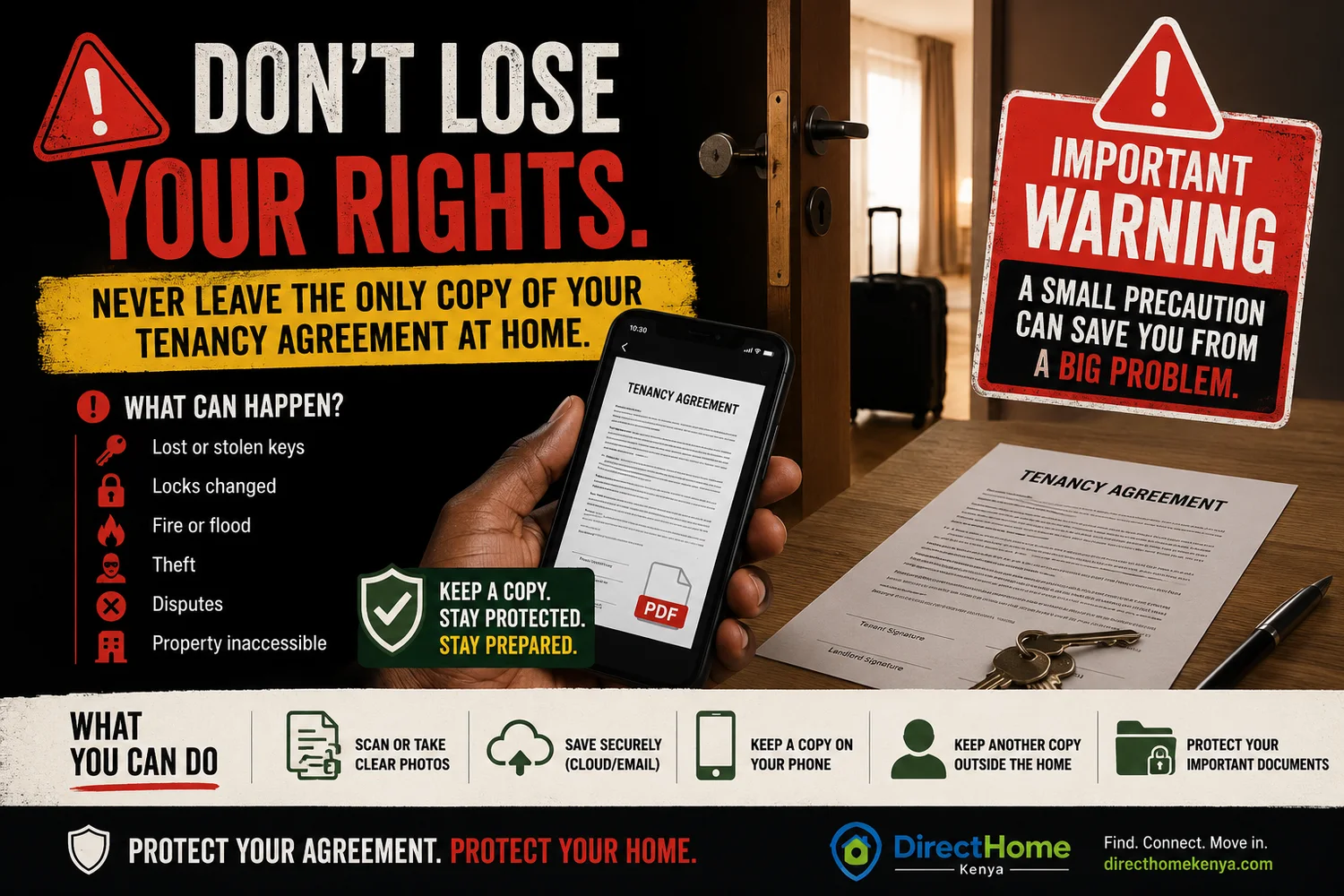
Never Leave the Only Copy of Your Tenancy Agreement Inside Your Rental Home
A tenancy agreement may look like just another document, but when a problem happens, it can become one of the most important papers a tenant has.
It shows who rented the property, the agreed rent, the deposit, the rental period, the responsibilities of both parties and any other conditions accepted by the tenant and landlord.
For that reason, tenants should never keep the only copy of their tenancy agreement inside the house or apartment they are renting.
When travelling, visiting family or leaving the property for several days, always take a copy with you or make sure you can access one from outside the home.
Even a clear scan or photograph saved securely on your phone is better than having no copy at all.
Why Keeping the Only Copy at Home Can Be Risky
Most tenants keep important documents together in a drawer, bag or folder inside their home.
This feels natural. The tenancy agreement relates to the property, so keeping it inside the property may seem logical.
The problem begins when the tenant cannot access the house.
This could happen because of:
- lost or stolen keys;
- a damaged lock;
- a fire or flood;
- theft;
- an emergency evacuation;
- an unexpected dispute;
- someone changing the locks;
- the building becoming temporarily inaccessible.
These situations may never happen. However, when they do, the tenant may suddenly need the tenancy agreement while the only copy remains locked inside the property.
A document cannot protect you when you cannot reach it.
Your Agreement Helps Show Your Right to Occupy the Property
A tenancy agreement can help show that you are not a stranger trying to enter someone else’s home.
It may contain:
- your full name;
- the landlord’s or property manager’s details;
- the address of the rented property;
- the start date of the tenancy;
- the agreed rent;
- the deposit amount;
- the duration of the tenancy;
- signatures of the parties;
- important rules or conditions.
The agreement does not automatically resolve every dispute, and tenants may sometimes need additional documents or professional advice.
However, having access to it can help you explain your situation and provide evidence of the arrangement you entered into.
Without a copy, it may be more difficult to confirm what was agreed.
Do Not Wait Until There Is a Problem
People often create backup copies only after losing an important document.
By then, it may already be too late.
Creating a backup of your tenancy agreement takes only a few minutes.
You do not need expensive equipment or complicated technology. A smartphone is usually enough.
The important thing is to create the backup while you still have access to the original document.
The Minimum Protection: Take Clear Photos
Open your tenancy agreement on a flat surface and take a clear photograph of every page.
Before saving the photos, check that:
- the full page is visible;
- the text can be read;
- signatures are visible;
- no section is covered by a hand or shadow;
- the images are not blurred;
- every page has been photographed;
- the pages are saved in the correct order.
Do not assume the photos are readable simply because they exist on your phone.
Zoom in and check the important details.
A photograph that cannot be read may not be useful when you need it.
A Scan Is Better Than a Random Photograph
Where possible, use a document-scanning application on your phone.
Many modern phones and free applications can scan paper documents and save them as a single PDF file.
A scanned PDF is often easier to:
- read;
- store;
- organise;
- send;
- print;
- access later.
Name the file clearly.
For example:
Tenancy Agreement – Property Address – 2026.pdf
Avoid names such as:
- document1.pdf;
- scan004.pdf;
- new file.pdf.
A clear file name will help you find the agreement quickly during a stressful situation.
Keep More Than One Backup
Saving the agreement only on your phone is better than having no backup, but phones can also be lost, damaged or stolen.
A safer approach is to keep several copies in different places.
For example:
- Keep the original paper agreement in a safe place.
- Save a scanned copy on your phone.
- Store a secure digital copy in a trusted cloud account or email account.
- Keep a second paper copy outside the rented property.
- Give a copy to a trusted family member where appropriate.
The copies should not all be stored in the same bag, room or device.
The purpose of a backup is to remain available when the original is lost or inaccessible.
What to Take When You Travel
You do not always need to carry the original paper agreement when travelling.
The original may be safer in secure storage.
However, before leaving your rental home for several days, make sure you have access to at least one complete copy.
This could be:
- a scanned PDF on your phone;
- a secure cloud copy;
- an email containing the document;
- a paper photocopy;
- a copy held by a trusted person.
Check that you can open the file without needing access to a device, password or internet connection that may not be available.
For important journeys, it can be helpful to save a copy directly on the phone so it can be opened offline.
Keep Related Evidence as Well
The tenancy agreement may not be the only useful document.
Tenants should also consider keeping secure copies of:
- rent payment receipts;
- deposit receipts;
- M-Pesa payment confirmations;
- bank transfer records;
- messages about the tenancy;
- property inspection records;
- photographs taken when moving in;
- inventory records;
- written notices;
- contact details for the landlord or property manager.
These records can help show what was paid, what condition the property was in and what communication took place.
Do not rely entirely on chat messages. Conversations may be deleted, phones may be changed and accounts may become inaccessible.
Important information should be saved separately.
Protect Your Personal Information
A tenancy agreement may contain sensitive personal information.
Do not send it to strangers or post it publicly online.
When storing a digital copy:
- use a secure device;
- protect your phone with a PIN, password or biometric lock;
- use a trusted cloud or email account;
- enable two-factor authentication where possible;
- avoid saving it on shared public devices;
- do not share the document unless there is a genuine reason.
When giving a copy to another person, choose someone you trust.
A backup should improve your security, not create a new privacy risk.
Check Your Agreement Before Signing
Before making backup copies, read the agreement carefully.
Confirm that it contains the correct:
- tenant name;
- landlord or agent details;
- property address;
- rent amount;
- deposit amount;
- payment dates;
- tenancy period;
- responsibilities;
- signatures.
Do not sign a blank or incomplete document.
Ask questions about any condition you do not understand.
Keep a copy of the final version signed by all relevant parties, not only an unsigned draft.
What If You Never Received a Copy?
A tenant should not assume that the landlord or agent will always provide the agreement later.
When signing, request your own copy immediately.
Where possible, do not leave the meeting with only a promise that the document will be sent another day.
If the agreement is signed electronically, download and save the final signed version.
If it is signed on paper, photograph or scan it before handing it back, especially when you are not immediately given your own copy.
Make sure the copy includes every page and signature.
A Simple Rule for Every Tenant
The safest rule is simple:
Never leave the only copy of your tenancy agreement inside the property you are renting.
Keep the original safely, but make sure another copy remains accessible from outside the home.
It does not need to be complicated.
A clear scan on your phone, a secure copy in your email and one paper copy kept somewhere else may be enough to prevent a difficult situation from becoming worse.
Your tenancy agreement is evidence of an important arrangement.
Treat it like an important document, not like an old piece of paper hidden at the bottom of a drawer.
Final Checklist Before Leaving Home
Before travelling, ask yourself:
- Do I have a complete copy of my tenancy agreement?
- Can I open it from my phone?
- Is every page readable?
- Are the signatures visible?
- Do I have the landlord’s or property manager’s contact details?
- Do I have copies of recent rent payments?
- Is another backup stored outside the property?
If the answer to any of these questions is no, create the missing backup before leaving.
A few minutes of preparation can save hours of stress later.